
As part of a new series of posts I will be doing called Cemetery Focus, I have made the decision to start away from the Western Front. Recently, I went on holiday to Malta for a week. Whilst the purpose of the holiday was obviously to relax, as anyone who loves history knows, I could not pass up the chance to explore all the history the island has to offer – particularly the military history of the 20th Century. I will be writing a series of posts on our time in Malta but in this first post, I will be focusing on my visit to a military cemetery – Pieta.
During the First World War, Malta was not directly involved in any fighting. Due to its location in the Mediterranean and having a deep-water port in Valletta, the island’s importance to the war effort grew and as such, Malta did find itself subjected to submarine warfare – which increased in the summer of 1917. Not only was it a centre of planning, but Malta also became known as ‘The Nurse of the Mediterranean’ – for the role it played in treating over 135,000 sick and wounded men and women, mostly from Gallipoli and Salonika.

When planning this holiday, I knew if there was one location I could go to, it simply had to be Pieta Military Cemetery. Pieta has been used as a military cemetery since 1866 for soldiers, sailors, and their families but most of the burials are from the First World War – over 1300 out of 2256. Due to the topography, with the ground being essentially almost completely rock, there are multiple burials in each plot. There is so much to see in this small site ( I was there for an hour and a half – not sure Mr Beth realised it was possible to be in a cemetery for so long!) it would be impossible to talk about all of the stories I encountered there, so I will take a small selection of interesting headstones that I found to talk about in this article.

The first burial I am highlighting in this article is the grave of Dr Isobel Addey Tate, who died on 28th January 1917. Isobel was born in 1874 in Portadown, County Armagh, Northern Ireland to a Methodist family. Isobel was a well-educated young woman, and obviously intelligent as she studied at Queen’s College Belfast, where she graduated with a medical degree in 1899. After registering as a doctor, she moved to England, working in Beverley, Oxford, Burnley, Shropshire, and Preston. At the outbreak of war, the military authorities decided they did not want the help of female doctors, one of whom was told upon volunteering to ‘go home and sit still.’ But this did not put these women off, quite the contrary. They found other ways to serve, including seven female surgeons and doctors in the Serbian Relief Fund, which is what Isobel did. Whilst serving with the unit, Isobel contracted Enteric Fever (also called Typhoid) and was sent back to the UK to recover. Eventually Isobel felt she needed to be doing something so volunteered again and was sent to Malta in August 1916. However, she never truly recovered from her bout of Typhoid and died on 28th January 1917 with her official cause of death as ‘Congestion of the brain due to Typhoid Fever’. Isobel was 43 years old.


Death and serious injury are inescapable parts of war. Many thousands of young men whose bodies had been torn apart. But what this does is encourage doctors, nurses, and other medical and scientific professionals to develop new ways of treating the sick and wounded; and the First World War was no exception to this. Blood transfusions and banks, brain surgery, Thomas Splints and X-Rays were just a few of the many medical developments that were either made or adapted from their pre-war use. One such First World War example only came to light in the last 10/15 years – that of the case of Private Robert Hugh Martin of Walkley, Yorkshire. After enlisting in Chesterfield, Pte Martin was serving with the 1st Bn Derbyshire Yeomanry in the Salonika Campaign when he was shot in the chest by the enemy – possibly by a Bulgarian soldier – and had a bullet lodged in his heart. This happened on 14th November 1917, his 21st birthday.
Cardiac surgery was extremely rare at this point in time, in fact, a lot of medical history books state it wasn’t happening until the 1920s. But research undertaken by Maltese surgeon Dr Norman Briffa shows that cardiac surgery was being undertaken during the First World War. Pte Martin is believed to be (pending further cases coming to light) the first person to have and survive heart surgery. The surgery was undertaken at St Elmo’s hospital in Valletta on 14th January 1918 and the outcome was successful – being reported at the time in the Daily Malta Chronicle as ‘attracting extraordinary interest and attention’ and being ‘the talk of the island’. However, on 14th March 1918, two months after his operation, Pte Martin died as a result of septicaemia. Whilst he may not have survived the war, Pte Martin is a key example of the importance of medical developments in war.

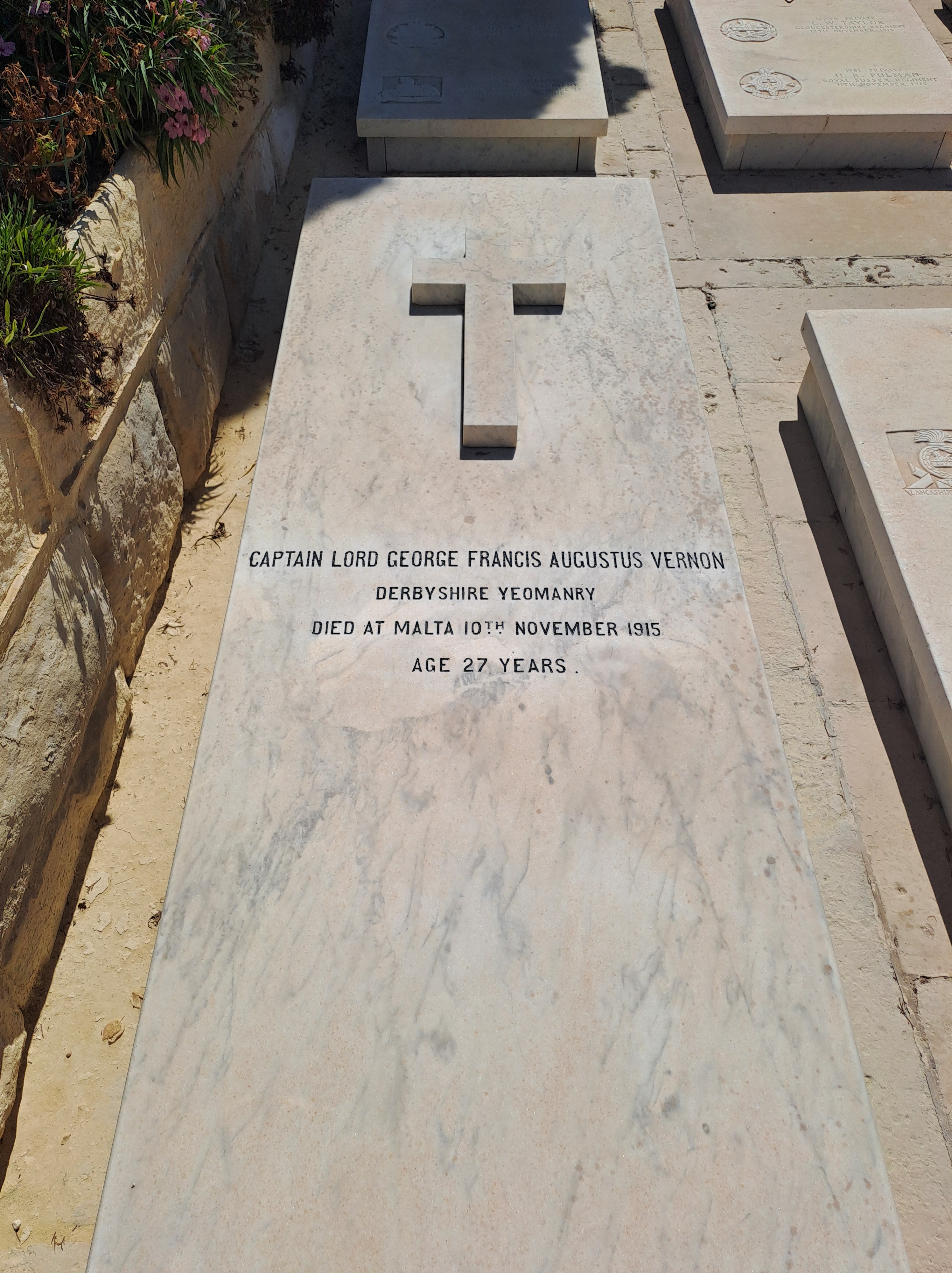
As we know from other military cemeteries around the world, British and Commonwealth burials of the two world wars tend to have similar headstones. However, there are always exceptions to the rule. Around the world, there are several locations where personal headstones of the men commemorated there had been erected by their family or unit, and their wishes were for them not to be replaced. In Pieta, there are many such examples including that of Captain Lord George Francis Augustus Venables-Vernon, 8th Baron Vernon.
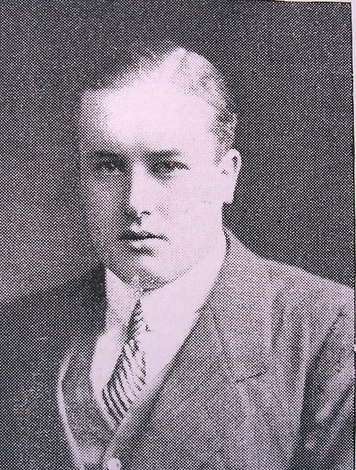
Born in 1888 at Sudbury Hall, George became the 8th Baron at the age of ten when his father died. After being educated at Eton College and Christ Church, Oxford, George was commissioned as a 2nd Lieutenant in the Derbyshire Yeomanry in 1906, eventually reaching Captain by the time war broke out in 1914. George went with the unit out to the Middle East, serving in Egypt and Gallipoli – taking part in the Battle of Scimitar Hill. It was whilst in the awful conditions experienced in Gallipoli that George contracted dysentery – a disease caused by poor hygiene and sanitation, passed through flies and drinking water. He was medically evacuated to Malta where he died on 10th November 1915 at the age of twenty-seven. A shocking statistic of Gallipoli is that of the around 215,000 casualties, around 140,000 were caused by sickness.
The two following examples also died whilst serving in Gallipoli, and again, both of them due to sickness. I decided to post about the two of them because their personal inscriptions chosen by their families caught my eye.
The first of these is Private Hubert Rigaud Rathbone. Born in Granton, Tasmania and the son of Frank and Isabella Rathbone, Hubert is described on his enlistment papers as a farmer, 5ft8, 10st, with a medium dark complexion, brownish green eyes, and dark brown hair. He enlisted on 26th May 1915, and was taken on the strength of 12th Bn Australian Infantry on 6th August 1915 at Gallipoli. However, within 7 weeks, Hubert was suffering from Enteric Fever (also known as Typhoid Fever). He was admitted to a Casualty Clearing Station on 21st September 1915, taken to hospital on 22nd, was evacuated and arrived in Malta on 27th September. His family received a telegram on 30th September, informing them that Hubert was seriously ill. On 10th October 1915, Hubert died as a result of the Enteric Fever and Pneumonia as well. He was 22 years old. The inscription on his headstone reads ‘Of whom all our thoughts are pure gold without alloy.’ Sadly, this is also the same inscription that features on the headstone of Percy, Hubert’s brother, who died on 14th April 1918, after a double leg amputation due to severe leg wounds. Percy is buried in Wimereux Communal Cemetery.


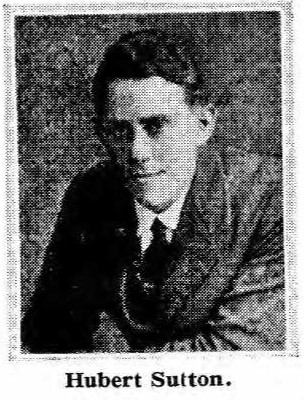
The final headstone that I will be highlighting in this piece about Pieta Military Cemetery is that for Lance Corporal Hubert Sutton. Originally from Streatham, before the war he was a commercial traveller before joining A Squadron Surrey Yeomanry in 1913. He was fond of sport, literature, and writing. He volunteered for overseas service when war broke out and was moved to C Squadron which left for Egypt in March 1915. He arrived on the Gallipoli peninsula on 3rd August and was only there for a few short weeks before dying on 21st August aged twenty-two of Enteritis on a hospital ship (inflammation of small intestine, made worse by appalling sanitation and a huge infestation of flies). The inscription chosen by his parents Oswald and Hannah was actually from a piece of Hubert’s own poetry and reads ‘Love and battle make life noble, time flies fast but time is long. H.S.’ After his death, his parents published some of his written works in a short book called ‘Fragments of Verse.’

Over the coming posts, I will be writing about Capuccini Naval Cemetery and Military Cemetery in Cemetery Focus, alongside other posts about Malta and the the Western Front. If you have any questions about any of my posts, or other things you would like to discuss about the First World War, please head to the contact page and send me a message.
 historyandmoore.com