

On a recent trip to the battlefields over Remembrance weekend, I spent time travelling around cemeteries that I hadn’t visited before, with the intention of taking pictures of certain headstones for an ongoing project I have of visiting all the men from my local area who were killed during the war – further details of which, you can find here.

However, as many will know, it’s never just as straightforward as going into the cemetery, finding the headstone you require, taking a photo of it and then leaving. Inevitably, something will grab your attention – usually a headstone with an inscription you find interesting or thought provoking, or sometimes it might be an individual who is commemorated in a different fashion. On this occasion, whilst visiting Heilly Station Cemetery near Mericourt L’Abbe, what caught my eye was the latter of the two – a young man whose headstone was markedly different from those around him, not just in style, but in content as well. On the marker was engraved,
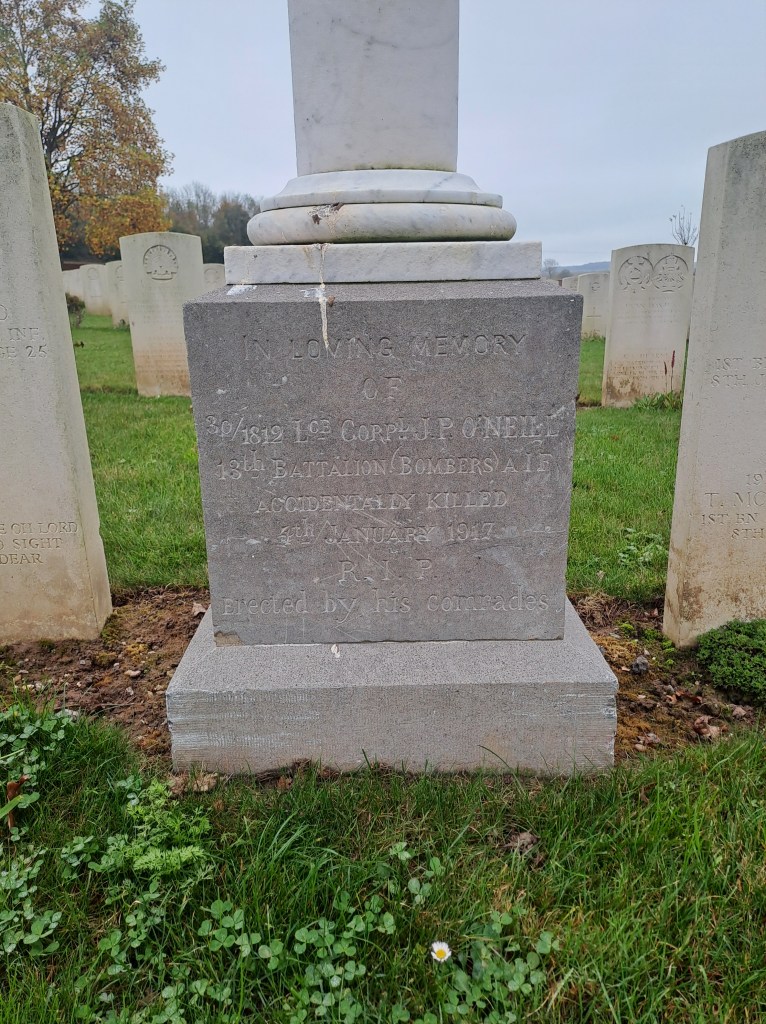
‘In loving memory of 30/1812 Lance Corporal J.P. O’Neill, 13th Battalion (bombers) AIF, accidentally killed 4th January 1917. R.I.P. Erected by his comrades’
Such an unusual grave marker, so distinctive in its style, has warranted some research on the individual concerned, and subsequently has led to this blog post – to highlight his story.
Private John Patrick O’Neill was born in West Maitland, Australia in January 1895 to James and Margaret O’Neill. On his enlistment papers from July 1915, he is shown as 20 years and 6 months old and working as a station hand. John’s description on his enlistment papers states he was 5ft 7.5in, weighed 135lbs, had resting and extended chest measurements of 31 and 34 inches respectively, had a fair complexion, grey eyes and dark hair. He was allocated and taken onto the strength of 13th Battalion, Australian Imperial Force in March 1916, before heading to the Western Front with his unit on 1st June 1916, where James and his unit were involved in the fighting at Pozieres in the August of that year. In October 1916, John was promoted in the field to Lance Corporal.

18 months into his army service, on 4th January 1917, John was killed at the age of 21. His service record states on that he died of an accidental head wound received at bombing school. Based on the records, this would appear to be the Anzac Corps School which had been set up in Aveluy in November 1916 to teach soldiers in ‘bombing’ – the use of grenades, signalling, trench mortars to name but a few.
As a result of John’s death, a Court of Inquiry was set up to establish the details of the accident. The findings were,
‘The court is of opinion that the accident was unavoidable. It was entirely owing to faulty construction of the grenade, and this cannot be obviated by any precaution taken when preparing the grenade for firing. Incidentally, this is the first accident since the formation of the school. The casualties would have been just as severe in the deepest of trenches as the burst was so close. I am of opinion that the cause of the premature burst was in the fuse. Possibly instantaneous fuse, or faulty composition. It is not possible to detect such beforehand. Lt-Col AM Ross, Commandant.’
At some point after his death, John’s comrades raised a substantial private memorial in his honour. A mark, no doubt, of their esteem for him and possibly sadness at the circumstances of his death.

After the war ended, the long process of creating the cemeteries started and with that brought the question of what to do with private memorials that had been erected over the burials of some soldiers. L/Cpl O’Neill’s own private memorial was now one of these. Contained within his service record is a copy of a letter from the then Imperial War Graves Commission, that was sent to the officer in charge of base records at Victoria Barracks in Melbourne, asking that contact be made with John’s family and see if they would be happy with changing the private memorial to a standard headstone. The letter wishes for the officer to convey to John’s family that
‘It is the view of the Commission that as all those who have fallen in the War have made the same sacrifice; equal honour should be paid to their memory by the Empire for which they gave their lives.’
Additionally, that
‘The Commission wish to point out that if the memorial already erected is allowed to remain, it will necessarily be out of keeping with their general scheme which is based on the principle of equality of treatment for all war graves.’

The response that the Commission received from the officer indicated that, unsurprisingly, the family wished for the memorial to stay in place, as seen below

I find this exchange of letters interesting, as it shows the ongoing task of the Imperial War Graves Commission to obtain equality within their cemeteries, but also their respect of the wishes of the families of the men they were to commemorate. It also goes to show, that there is always an exception to any rule.
 historyandmoore.com